
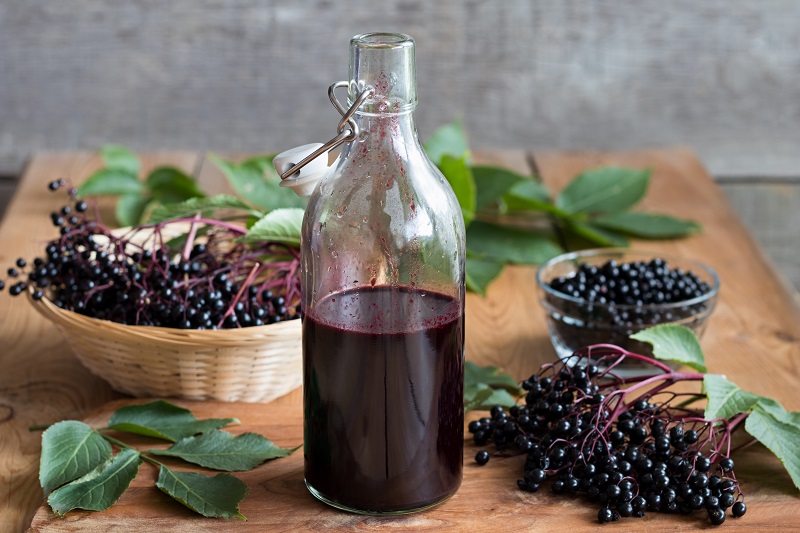
We’re nearly halfway through summer but it’s a good idea to think about winter – and after the year we’ve had looking at natural foods to help with fighting winter’s illnesses.
The berries are really starting to fatten up, summer fruits are ripening and on warm summer days, their aroma may draw your attention.
Elderberries offer a cheap way to fight off colds and flu, many studies have been done to study their natural virus fighting, bacteria quashing properties and their is a lots of evidence to back it up.
On a very simple level the effects of syrups on a tickly cough is shown to work, the thick sugar solution coats the throat and eases a cough. This is true whether the syrup is sugar, made from pineapple or even honey.
Cooked only!
Elderberries themselves are poisonous raw, like apple and pear seeds, the leaves, stems and berries contain cyanide – so don’t go adding them to a smoothie.
But cooked, boiled then simmered into a syrup, well the effects are much more enjoyable and you can bolster your nutrient intake on a daily basis.
Cooking destroys their nutrients
Ok so here we have a bit of a dilemma, raw can cause stomach upsets, yet cooking destroys vitamins and nutrients and sugar is an immunosuppressent.
Sugar
Only the berries are used, and sugar is used to preserve them, make them taste a bit better and provide that cough soothing syrup.
Add flavours and other medicinal foods for even more delicousness and flu-fighting abilities, such as ginger, lemon, orange, cinnamon and honey. You can use all honey if you prefer.
Worth the time!
You need to only use the berries, not even the tiniest bits of stalk as these contain tanins. Forking the berries off the stalks is a popular way, some say to remove every last trace of stalk but others say not to fuss about little pieces.
Does cooking destroy the health properties?
A study conducted in 2004, on a smallish selection of people certainly indeicated that despite being processed into a syrup, the potent power of elderberries still worked their magic. The study was a double blind, placebo controlled study in Norwiay [See link]
Study in 2016
Elderberry extract, larger study group. Still showed to lessen the duration of a cold by 2 days.
[See link]
Tinctures
Tinctures can sidestep the processing issues, you can use the berries raw, so avoiding the heat and sugar issues. Using raw apple cider vinegar also provides health giving properties.
Pros: It’s easier, less processing.
Cons: takes 6 weeks to ‘do’.
Recipes
Elderberry tincture
Mash berries to break them down. Add to a glass jar and top with cider vinegar. Leave in a dark place for 6 weeks – shake occassionally – before straining and bottling, discard the berries when done. Due to the vinegar content, this is the longest lasting method.
Elderberry syrup
Ingredients:
Freshly picked elderberries, dark and ripe, plump.
Flavours: cinnamon, ginger, cloves, all-spice, star anise.
Sugar (or honey)
Method:
In a pan, simmer the berries in enough water to cover them. Strain to remove any pips.
Add 400g sugar for every pint of liquid in a clean pan, add your extra flavours. Gently heat till all the sugar is dissolved and boil for 10 minutes.
Strain and pour into warm steralised containers. We use a knife in bottles to prevent the bottles from cracking in the heat.
Stores in fridge for 3 months, in the freezer for a year. Process in a pressure canner/water bath for longer storage time. Check for mould before consuming.
You could also make them into jam/jelly. Couple with blackberries for a delightful hedgerow jam to add their health boosting ability on your morning toast.
Hedgerow Jam
Ingredients:
1kg Elderberries and blackberries
500g sugar
Lemon/orange sliced
Small amount of water
Spices for flavour, cinnamon stick.
Method:
Put the berries, citrus, water and spices in a pan, bring to the boil and simer till soft.
Run the fruit through a sieve to remove any pips etc. Return to the pan and add the sugar. Bring to the boil and cook for around 10-15 minutes, until setting point is reached before packing into steralised jars.
Setting point.
Once you’ve made jam a fair few times, you will know when it’s ready by the consistency. The appearance darkens, gets thicker and the sugar has become very syrupy.
Setting point can be guaged easier with a jam thermometer or by using a cold saucer and checking for the wrinkling of a small amount of jam placed on it.
Stores for about a year.
Disclaimer, we believe that elderberry syrup has amazing properties but that is an opinion. Science does appear to back this up but there is no guarantee. Also the effect of elderberries on COVID is not very well documented.
Elderberry syrup is a lovely way to add a bit of summer to your winter, be it as a cocktail with a mixer of cava, drizzled over a scoop of icecream or added to a mug of mulled wine and it may well do you some good.